|
Increased
sales For
Engineering Procurement Construction; Advertising, Business Development,
Austin, Texas marketing@EngineeringProcurementConstruction.com
|
|
Increased
sales For
Engineering Procurement Construction; Advertising, Business Development,
Austin, Texas marketing@EngineeringProcurementConstruction.com
|
Engineering
Procurement Construction
www.EngineeringProcurementConstruction.com
What is Engineering Procurement
Construction?
Engineering Procurement Construction, also referred to as; Engineer Procure Construct and "EPC" is the terminology used when an owner, for example, is seeking to build a new cogeneration power plant uses when the owner is seeking a "turnkey" project solution. EPC contracts are not only a very common form of contracting within the construction industry, but increasingly becoming the norm, particularly in the electric power generation (power plants) and utility sector.
The construction company, via the EPC contract with the owner, provides for the design, engineering, procurement of all related supplies, components, materials, labor, services, etc. The contractor, with approval/permit by EPC contract with the owner, may sub-contract part of the work.
"'Net Zero Energy' is the 'Holy Grail' for Energy
and
'Way Beyond
Solar!'" sm
"Net Zero Energy" Revenues to Reach $690 Billion by 2020
and $1.3 Trillion by 2035" ~ Navigant Consulting
Thanks electric utilities and electric grid,
we'll take it from here!
|
Concentrated PV * Concentrated Solar Power * EcoGeneration * Molten Salt Storage * Net Zero Energy Pollution
Free Power
* Power Purchase Agreement
* Utility
Scale Wind
* Waste
Heat Recovery *
Zero
Emission Power
|

marketing@EngineeringProcurementConstruction.com
What is Utility Scale Power?
"Utility scale power" projects may also be referred to as "Central Power Plants" that typically generate hundreds of megawatts of power which is exported (dispatched or wheeled) to the electric grid, which is transmitted tens or even hundreds of miles away to "load centers."
What is Utility Scale Wind?
"Utility scale wind" projects and "wind farms" are locations where hundreds of megawatts of wind turbine generators are installed with the power generated being "exported" to the electric grid, which may be "wheeled" tens or even hundreds of miles away to "load centers."
Wind
Power Generation Facts: (some from AWEA.org)
For every megawatt (MW) of wind energy produced, $1 million in economic development is generated. This includes revenue from planning, construction, etc.
Wind energy revitalizes rural communities by providing steady income through lease and royalty payments to farmers and other landowners.
Supplemental income: It is estimated that the income to a landowner from a single utility-scale turbine is approximately $2000 per year. For a 250-acre farm with income from wind at $55 per acre, this translates into an annual income from wind leases of $14,000, with no more than 2-3 acres removed from production.
Jobs: Wind energy resources bring needed jobs to rural communities and bolster farm incomes against bad weather. Worldwide, wind and solar industries are likely to be one of the main sources of new manufacturing jobs in the 21st century.
Wind energy costs for consumers are low and stable. This is particularly beneficial for those on fixed incomes.
As wind energy production becomes more efficient, costs will decline, while fossil fuel prices are expected to rise.
Wind energy is a widespread, inexhaustible resource: 46 of 50 states have wind resources that could be developed.
Wind Energy Generates Zero
Emission Energy and Pollution
Free Power
Power generated from the wind reduces smog and eliminates a major source of acid rain. Wind energy has the potential to reduce Carbon Dioxide Emissions (one of the most potent of all Greenhouse Gas Emissions) by 1/3 in the U.S. and world Carbon Dioxide Emissions by 4%!
Potential for growth: Development of just 10% of 10 of the windiest states could provide more than enough energy to displace emissions from coal-fired power plants.
Cleaner air means healthier air, especially for people with respiratory disabilities.
Wind Power Generation vs. Traditional Power Generation
Power generated from clean, green wind energy avoids numerous negative effects of traditional electricity generation from fossil fuels:
• Emissions of mercury or other heavy metals into the air
• Emissions associated with extracting and transporting fuels
• Lake and streambed acidification from acid rain or mining
• Water consumption associated with mining or electricity generation
• Production of toxic solid wastes, ash, or slurry
• Greenhouse Gas Emissions
The benefits of wind power generation go on - including the leading role wind energy provides in reducing Carbon Dioxide Emissions into the atmosphere - the leading cause of climate change and global warming. Today, Carbon Dioxide Emissions in the United States approaches 6 billion metric tons/year.
39% of these Carbon Dioxide Emissions are produced when electricity is generated from fossil fuels.
If the United States obtained 20% of its electricity from wind energy, the country could avoid putting 825 million metric tons of CO2 annually into the atmosphere by 2030, or a cumulative total of 7,600 million metric tons by 2030.
A relatively straightforward metric used to understand the carbon benefits of wind energy is that a single 1.5 MW wind turbine displaces 2,700 metric tons of CO2 per year compared with the current U.S. average utility fuel mix, or the equivalent of planting 4 square kilometers of forest every year according to AWEA 2007.
What is Community Wind
Power?
Community wind power, also referred to as community wind are wind energy projects that are developed and owned at the "community" or city/local level.
Community wind power projects are owned by investors as well as land owners at the community level where the community wind projects are located at. Typically, the owners/investors of community wind projects include; business owners, farmers, investors, the local utility company and public-private entities. The primary features of community wind power projects are that the local community members and stake-holders have a direct financial stake in the project beyond wind energy lease agreements (the land-owners where the wind turbines are installed) and tax revenues.
Community wind power projects are NOT "utility scale wind" where hundreds of megawatts of wind turbine generators are installed, and the power generated is exported to the grid. Community wind power projects are often sized so that 100% of the power generated is used in the community.
What is "Net Zero Energy?"
Net Zero Energy - when applied to a home or commercial building, simply means that they generate as much power and energy as they consume, when measured on an annual basis.
The U.S. Army now has a Net Zero Energy initiative to help reduce/eliminate America's use of foreign oil - particularly oil from muslim/middle-east countries - which literally saves the lives of our brave boys /soldiers in the military.
Our Founder was first involved in Net Zero Energy in 2001 - 2002 with consulting engagements and investments in multiple real estate developments, renewable energy technologies, solar cogeneration and solar trigeneration systems, Brad Pitt / Global Green Rebuild New Orleans Competition and the Solar Decathlon competition.
We provide Net Zero Energy and off-the-grid architectural & custom home/commercial buildings anywhere in the USA.
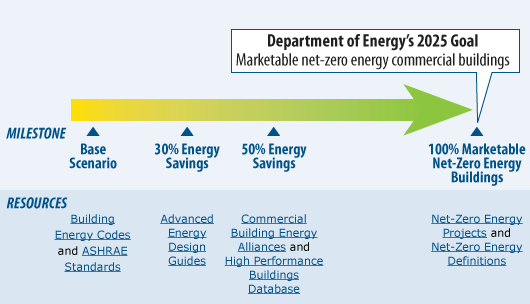
Department
of Energy's "Net Zero Energy" 2025 Goal
Marketable Net Zero Energy Commercial Buildings
______________________
Net Zero Energy Buildings Are
The Next Frontier
http://www.sustainablebusiness.com/index.cfm/go/news.display/id/23361
Revenue from net-zero energy buildings will grow rapidly over the next 20 years, reaching almost $690 billion
by 2020 and nearly $1.3 trillion by 2035, projects Pike Research. That's a compound annual growth rate of 43%.
______________________
Revenues From Net Zero Energy Buildings
to Reach $1.3 Trillion by 2035
http://www.navigantresearch.com/newsroom/revenue-from-net-zero-energy-buildings-to-reach-1-3-trillion-by-2035
______________________
Net Zero Energy Buildings Are Coming,
What About The Buildings Already Standing?
http://www.forbes.com/sites/justingerdes/2012/02/28/net-zero-energy-buildings-are-coming-what-about-the-buildings-already-standing/
What is Trigeneration?
A
trigeneration
plant is a cogeneration
power plant that has added absorption chillers for producing chilled water from
the heat that would have been wasted from a cogeneration power plant.
In addition to the economic benefits and advantages, trigeneration plants reduce
our dependence on foreign energy supplies and help our environment by
dramatically reducing greenhouse
gas emissions such as carbon dioxide - when compared to typical power
plants. Trigeneration
plants have been hailed the "hat-trick of the energy industry" with
system efficiencies approaching and exceeding 90%.
Trigeneration
plants are very energy efficient, conserve natural resources and reduce fuel
consumption as the system operates at such high efficiencies.
Cogeneration and trigeneration power plants are about 90% efficient and approximately 300% more efficient than "central power plants" that average 27% to 40% efficiency. When fueled with renewable fuel, cogeneration and trigeneration plants are carbon neutral, producing ZERO (net) greenhouse gas emissions and the optimum solution for clients seeking to reduce their energy expenses and greenhouse gas emissions.

Trigeneration
Diagram & Description
Trigeneration Power Plants' Have the
Highest System Efficiencies and are
About 300 % More Efficient than Typical Central Power Plants
What is EcoGeneration?
"EcoGeneration" is the term we created in 1999 to describe the economic
and ecological benefits and advantages of Clean
Power Generation, Pollution
Free Power and
a number of other "renewable
energy technologies."
The ecological and economic benefits we provide our clients translates directly into huge savings for our ecology by significantly reducing, and sometimes eliminating the pollution typically associated with power generation. The economic benefits our customers enjoy include saving as much as 90% of the costs they once spent for fuel, the public relations advantages that go hand-in-hand with EcoGeneration as well as the benefit of being viewed as a "good neighbor" by the communities they are located in.
EcoGeneration also seeks to minimize the "waste-heat" that is also present in the generation of power and energy
in about 500,000 smoke stacks found at power plants and other facilities that
have turbines and engines. Other sources of waste heat include; furnaces, boilers and chimney-stacks.
We provide engineering services relating to waste
heat recovery and assist our clients convert the waste-heat into other useful energy products such as electricity, hot water, steam and chilled water.
We call this "recycled
energy."
Depending on our clients' requirements, we may implement energy solutions that include technologies such as; cogeneration/combined-cycle, trigeneration, quadgeneration, absorption/adsorption chillers, hydrogen fuel cells, solar, geothermal and "waste to energy" or "waste to fuel" fuels such as organic diesel/soybean diesel, digester gas or landfill gas.
EcoGeneration provides not only ecological benefits, but also economic benefits, as we oftentimes reach and exceed system efficiencies of 90% - a dramatic increase over typical power plants that remain at only 27% - 33% efficient. What this means to our customers is they save huge amounts of money in the form of fuel savings, because the "waste-heat" we recover, is no longer wasted, since we are able to convert that waste-heat into the useful energy they need (hot water, steam and chilled water).
Clean Power Generation Systems
CHP
Systems (Cogeneration
and Trigeneration)
Plants
Have Very High Efficiencies, Low Fuel Costs & Low Emissions
The CHP System
below is Rated at 900 kW and Features:
(2) Natural Gas Engines @ 450 kW each on one Skid with Optional
Selective Catalytic Reduction system that removes Nitrogen
Oxides to "non-detect."
The Effective Heat Rate of the CHP System
below is
4100 btu/kW with a Net System Efficiency of 92%.


Our CHP Systems may be the best solution for your company's economic and environmental sustainability as we "upgrade" natural gas to clean power with our clean power generation solutions.
Our Emissions Abatement solutions reduce Nitrogen Oxides to "non-detect" which means our CHP Systems can be installed and operated in most EPA non-attainment regions!
Our CHP Systems
- (operating in either natural gas fueled cogeneration
or trigeneration
--- or --- solar
cogeneration or solar
trigeneration configuration) may be the optimum power and energy solution for
customers wanting increased power reliability and decreased energy and
environmental costs. A few of the
clients and markets that may benefit from our CHP
Systems include the following:
Airports
Casinos
Central Plants
Colleges & Universities
Dairies
Data Centers
District Heating & Cooling plants
Food Processing Plants
Golf/Country Clubs
Government Buildings and Facilities
Grocery Stores
Hospitals
Hotels
Manufacturing Plants
Military Bases
Nursing Homes
Office Buildings / Campuses
Radio Stations
Refrigerated Warehouses
Resorts
Restaurants
Schools
Server Farms
Shopping centers
Supermarkets
Television Stations
Theatres


|
Battery Energy Storage * Biomass Gasification * Balance Of Plant * Balance Of System * Biomass Gasification Concentrated PV * Concentrated Solar Power * EcoGeneration * Molten Salt Storage * Net Zero Energy Pollution Free Power * Power Purchase Agreement * Utility Scale Wind * Waste Heat Recovery * Zero Emission Power
|
marketing@EngineeringProcurementConstruction.com


Follow us on Twitter:
#Trigeneration
Engineering
Procurement Construction
www.EngineeringProcurementConstruction.com
marketing@EngineeringProcurementConstruction.com
EngineeringProcurementConstruction.com
Copyright
© 2003
All Rights Reserved
